Framework Character education and positive psychology

Research that shapes whole-student development.

Key scholars whose work informs how schools build character, wellbeing, academic readiness, and cultures where students can flourish.

Achievement Education Framework

Developed by David Vinson, PhD and grounded in 30 plus years of educational leadership and research.

The Achievement Education Framework is being developed by David Vinson, PhD, drawing from 30 plus years of educational leadership and research across positive psychology, character education, mindset, hope, readiness, leadership, and school culture.

The scholars listed below inform the framework's practical foundation. Achievement Education curriculum and activities are based on this research and aligned with the Texas Essential Knowledge and Skills (TEKS), helping schools connect whole-student development with the academic standards Texas educators use every day.

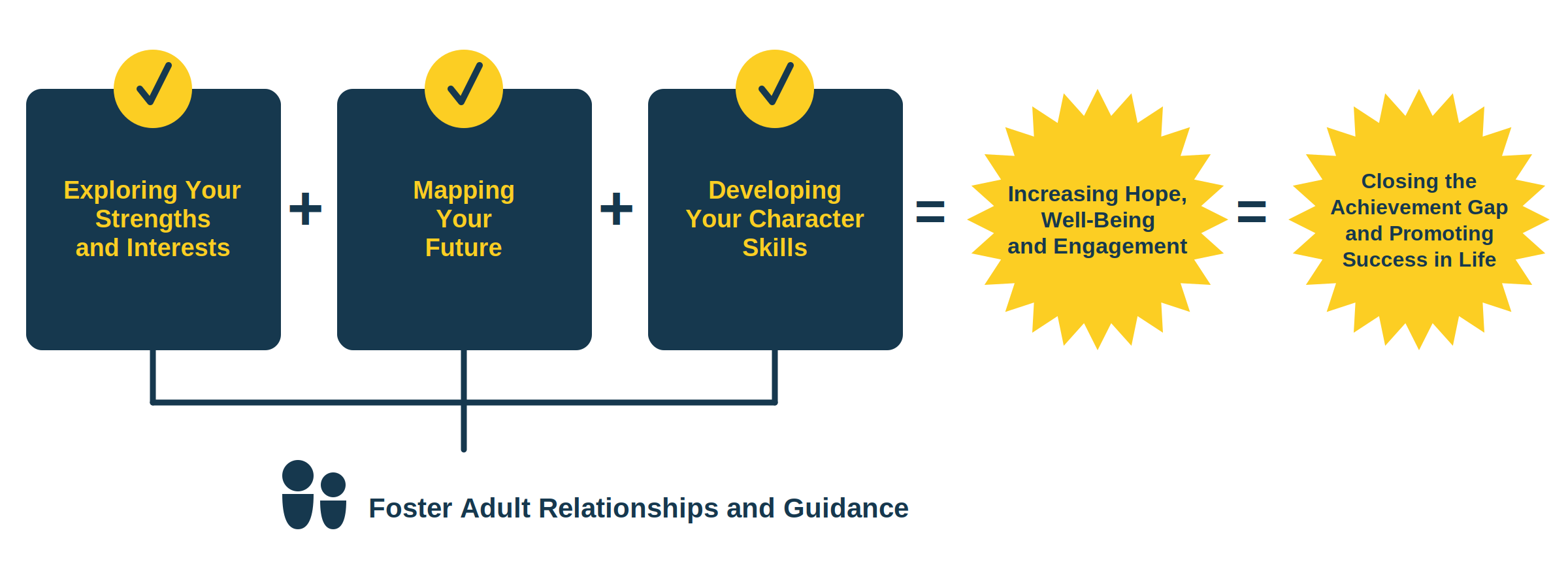
Achievement Education framework equation: exploring strengths and interests plus mapping the future plus developing character skills equals increasing hope, wellbeing, engagement, and closing the achievement gap while promoting success in life.
The Achievement Education Framework connects student discovery, future planning, character skill development, and adult guidance to measurable gains in hope, wellbeing, engagement, and long-term success.
Research base

Four bodies of work, one practical foundation.

Achievement Education draws from positive psychology, mindset and readiness research, modern character education, and applied culture-building. Together, these disciplines help schools move from isolated programs to coherent systems for student growth.

01
Wellbeing

Flourishing, hope, optimism, meaning, happiness, and student engagement.

02
Readiness

Grit, growth mindset, self-management, and college or career preparation.

03
Character

Virtues, respect, responsibility, relationships, and whole-district implementation.

04
Culture

Performance environments, educator efficacy, hiring, leadership, and alignment.

Positive psychology & wellbeing

How schools cultivate flourishing.

These researchers frame wellbeing as something schools can intentionally develop, not merely observe.

Positive psychology research

Martin Seligman, PhD

University of Pennsylvania | Founder, Positive Psychology Center

Often called the father of positive psychology, Seligman helped redirect psychological science toward what makes life worth living. His PERMA model: Positive emotion, Engagement, Relationships, Meaning, and Achievement, became a widely used framework for school wellbeing programs and the intentional cultivation of strengths, virtues, and meaning.

Selected Publications

  • Positive Education: Positive Psychology and Classroom Interventions, Oxford Review of Education, 2009
  • Character Strengths and Virtues: A Handbook and Classification, Oxford University Press, 2004
  • Positive Psychology Progress: Empirical Validation of Interventions, American Psychologist, 2005
Hope research

Shane Lopez, PhD

Gallup Senior Scientist | Don Clifton Strengths Institute

Lopez was a leading researcher on hope and student success. Building on C.R. Snyder's theory, he brought hope research into schools through the Gallup Student Poll and argued that hope is a learnable, goal-directed mindset built from goals, pathways, and agency.

Selected Publications

  • Making Ripples: How Principals and Teachers Can Spread Hope Throughout Our Schools, Phi Delta Kappan, 2010
  • How Can Schools Foster Hope? Making Hope Happen in the Classroom, Phi Delta Kappan, 2013
  • Measuring and Promoting Hope in Schoolchildren, Handbook of Positive Psychology in Schools, 2009
Happiness research

Shawn Achor

Harvard University | Author, The Happiness Advantage

Achor's work challenges the idea that success produces happiness, arguing instead that positive brains support higher performance. His school-based work has focused on teacher happiness, optimism, adult culture, and measurable downstream effects on student outcomes.

Selected Publications

  • Positive Intelligence, Harvard Business Review, 2012
  • The Happiness Advantage, Crown Business, 2010
  • Big Potential, Currency, 2018
Grit, mindset & college readiness

What helps students persist, learn, and launch.

This body of research connects motivation, self-directed learning, and readiness for life beyond high school.

Grit research

Angela Duckworth, PhD

University of Pennsylvania | Founder, Character Lab

Duckworth developed the Grit Scale and studied sustained passion and perseverance toward long-term goals across demanding settings. Her work made grit one of the most visible bridges between psychology and character education, while Character Lab connects research directly to school practice.

Selected Publications

  • Grit: Perseverance and Passion for Long-Term Goals, Journal of Personality and Social Psychology, 2007
  • Self-Discipline Outdoes IQ in Predicting Academic Performance of Adolescents, Psychological Science, 2005
  • Character as Opportunity, Character Lab Research Reports, 2019
Growth mindset research

Carol Dweck, PhD

Stanford University | Lewis and Virginia Eaton Professor of Psychology

Dweck's research on implicit theories of intelligence transformed how educators understand motivation and failure. Her distinction between fixed and growth mindsets has become a foundational idea in social-emotional learning and character education.

Selected Publications

  • Motivational Processes Affecting Learning, American Psychologist, 1986
  • Implicit Theories of Intelligence Predict Achievement Across an Adolescent Transition, Child Development, 2007
  • Academic Tenacity: Mindsets and Skills That Promote Long-Term Learning, Bill & Melinda Gates Foundation, 2014
College readiness research

David Conley, PhD

University of Oregon (Emeritus) | Founder, EdImagine

Conley helped define college and career readiness through his four-key model: Think, Know, Act, Go. His framework expands readiness beyond academic skills to include self-management, metacognition, and awareness of postsecondary environments.

Selected Publications

  • Redefining College Readiness, Educational Policy Improvement Center, 2007
  • College and Career Ready, Jossey-Bass, 2010
  • New Conceptions of College and Career Ready, Journal of College Admission Counseling, 2014
Character education

How values become school culture.

Modern character education links shared virtues with relationships, implementation, and daily district practice.

Character education

Thomas Lickona, PhD

SUNY Cortland (Emeritus) | Founder, Center for the 4th & 5th Rs

Lickona is widely regarded as the father of modern character education. His work emphasizes respect, responsibility, and the shared role of schools and families in helping children develop sound moral judgment as part of education's core purpose.

Selected Publications

  • Educating for Character, Bantam Books, 1991
  • The Return of Character Education, Educational Leadership, 1993
  • Character Matters, Touchstone, 2004
Character Counts

Michael Josephson, JD

Founder, Josephson Institute of Ethics | Creator, CHARACTER COUNTS!

Josephson convened the 1992 Aspen gathering that produced the Six Pillars of Character: trustworthiness, respect, responsibility, fairness, caring, and citizenship. CHARACTER COUNTS! translated values into a non-partisan framework schools and communities could adopt.

Selected Works & Programs

  • CHARACTER COUNTS! The Six Pillars Framework, Josephson Institute of Ethics, 1992 and ongoing
  • Making Ethical Decisions, Josephson Institute, 1995 and updated 2002
  • Ethics of American Youth, biennial survey, 1992-present
Power of relationships

Marvin Berkowitz, PhD

University of Missouri-St. Louis | Co-Director, Center for Character & Citizenship

Berkowitz's PRIMED model synthesizes research on effective character initiatives: Prioritization, Relationships, Intrinsic motivation, Modeling, Empowerment, and Developmental pedagogy. His work argues that authentic adult-student relationships are the engine of character development.

Selected Publications

  • Research-Based Character Education, Annals of the American Academy of Political and Social Science, 2004
  • What Works in Character Education, Character Education Partnership, 2005
  • Toward a Science of Character Education, Journal of Character Education, 2017
District implementation

David Vinson, PhD

Superintendent, Wylie ISD | Founder, Achievement Education

Vinson developed the Wylie Way, a district model that integrates grit, wellbeing, hope, happiness, and rigorous academics into school culture. His work translates research from Lopez, Duckworth, Dweck, and Seligman into district-wide practice.

Selected Works & Resources

  • The Wylie Way: Building a Character-Driven Culture in Public Schools, Achievement Education
  • Achievement Profile: Measuring the Whole Student, Achievement Education
  • PhD Dissertation: Curriculum and Instruction, Texas Tech University
Performance, culture & educator efficacy

The adult systems that shape student experience.

School culture is built through leadership, hiring, modeling, and the everyday performance environment adults create.

What Drives Winning

Brett Ledbetter

Co-Founder, What Drives Winning | University of Florida

Ledbetter studies the mindsets and cultures behind sustained excellence in athletics, education, and business. His framework, that character drives the process and the process drives the result, translates directly to schools building performance with integrity.

Selected Works

  • What Drives Winning, What Drives Winning Press, 2014
  • What's Really Important, What Drives Winning Press, 2016
  • Question-Based Leadership, What Drives Winning Press, 2019
HR practices & teacher efficacy

Teresa Harrison (Johnson), PhD

University of the Incarnate Word | Associate Professor of Management

Harrison's research connects organizational values, human behavior, HR practices, and culture. For school leaders, her work reinforces the relationship between who a school hires, how adults are developed, and the culture students experience.

Selected Publications

  • Factors Affecting the Effectiveness and Acceptance of Electronic Selection, Human Resource Management Review, 2012
  • E-Recruiting Utilizing an Organizational Website, Journal of Managerial Psychology, 2018
  • Aligning Organizational Culture and Strategic Human Resource Management, Journal of Management Development, 2017

Compiled for educational reference. These researchers collectively represent the theoretical and applied foundations of character education, social-emotional learning, and positive psychology in K-12 schools.

Ready to make whole-student development visible?